
Article
Jun 16, 2026
Your Founder Win Rate Was Never Going to Survive Your First AE Hire
New AEs take roughly 4 to 6 months to ramp and often close at half the founder's rate. Here is how to codify a founder's objection handling into a documented playbook AEs can actually run.
Written by Sourav Ghosh
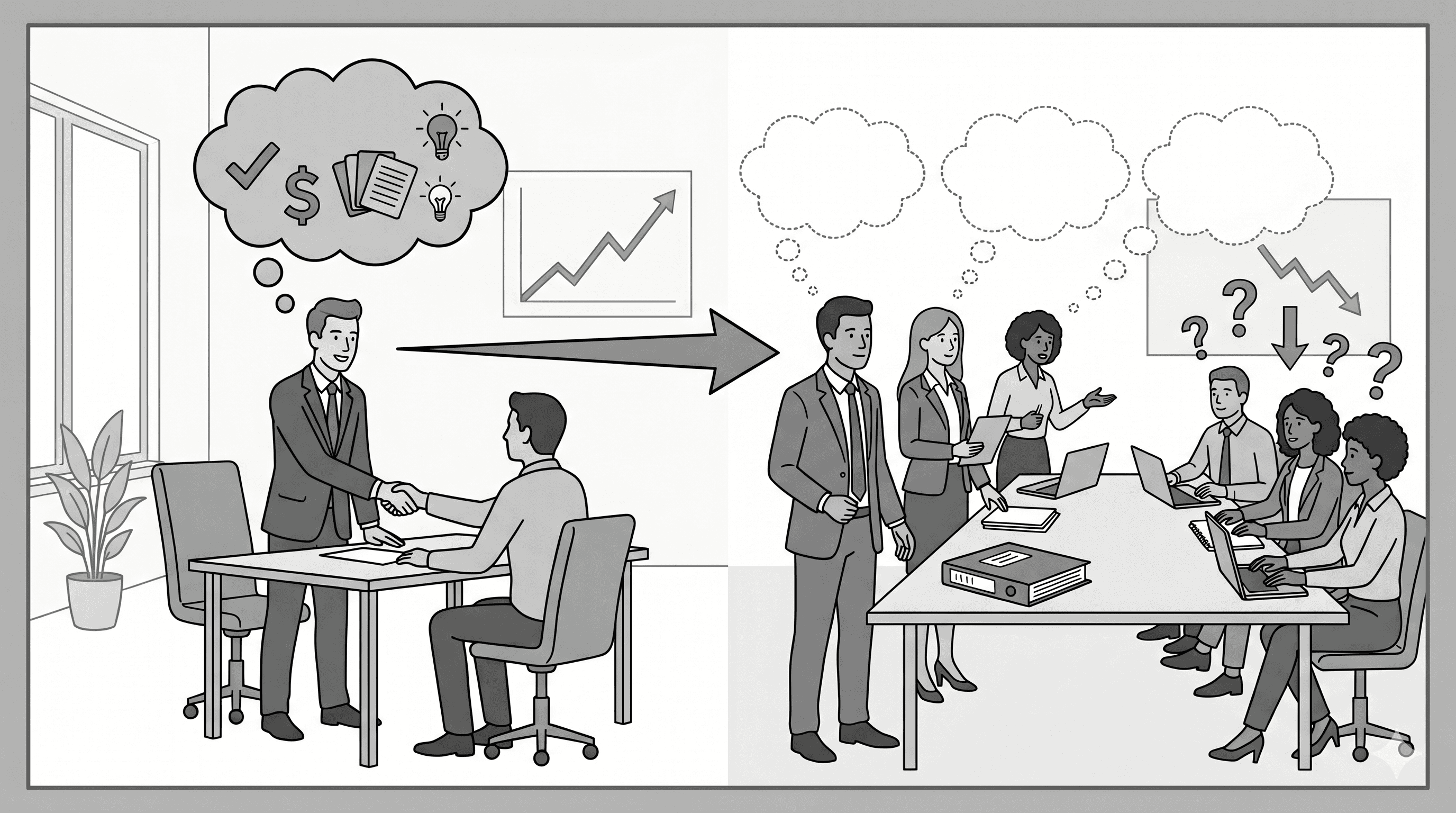
Your win rate dropped the day you stopped taking demos, and your new AEs are not the reason. The reason is that the entire selling system lived in your head as instinct, with nothing written down for a rep to copy, so the handoff reset the number close to zero.
The fix is mechanical, not motivational. Pull your own winning call recordings, extract the five objections you neutralize on reflex, and turn each one into a documented response a new AE can run on call three. The founder’s instinct becomes a battlecard, and the win rate stops depending on whether you personally are in the room.
TL;DR Founder win rate is undocumented tacit knowledge. New AEs take about 4.2 months to ramp (The Bridge Group), and close rates can fall 50 to 70% without a written process (Predictable Profits). Codify the founder’s objection responses from real call recordings into battlecards to hold the rate.
Why the win rate craters the week you delegate
In MarTech and RevOps, you closed the first logos yourself against an entrenched incumbent. You knew which objection was real and which was a stall, and you answered before the prospect finished the sentence. None of that was in a document. It was pattern recognition built over a few hundred calls.
That is exactly what does not transfer. Close rates fall by 50 to 70% when a founder hands deals to a first rep without a documented process, because the teams that hold their rate had the founder’s playbook written down and the ones that collapse did not, according to Predictable Profits’ 2025 analysis. The drop is a measurement of what you never wrote down.
It also takes a while to come back. The average AE at a growth-stage B2B SaaS company takes about 4.2 months to reach full productivity even with a formal onboarding program, and teams without one routinely need six months or more, per The Bridge Group’s 2024 benchmarks. Without a playbook, every rep is rebuilding your instinct from scratch on live deals.
The handoff hands the AE your hardest segment first
The cruelty of the transition is that the new rep inherits the worst deals. You kept the marquee accounts and the warm intros for yourself; the AE gets the cold, competitive, price-sensitive pipeline.
Win rate benchmarks split hard by deal size. Deals under $10K ACV close at roughly 28 to 35%, and the rate slides lower as ACV climbs, according to Optifai’s 2025 analysis of 939 companies. Your AE is selling the larger, more contested deals where your instinct mattered most, and they have none of it.
The room is also harder than it was. B2B buying groups have grown to 8 to 13 stakeholders depending on deal size, and in 2025 Gartner found 74% of buying teams hit unhealthy internal conflict before they decide. A founder navigates that committee on feel. A four-month-old AE needs a map, and you never drew one.
What the founder did | What the new AE inherits |
|---|---|
Closed warm, early logos | Cold, competitive pipeline |
Answered objections on instinct | A blank ramp doc and “shadow me” |
Navigated the committee by feel | 8 to 13 stakeholders, no map |
Knew the 5 real objections cold | Discovers them live, deal by deal |
Carried the playbook in their head | No written system to run |
What the teams that hold their rate do differently
They treat the founder’s brain as a data source to be mined, not a talent to be admired. The losing teams hope the new rep “picks it up.” The winning teams extract the founder’s winning moves from real recordings and write them into a system a rep can run in week one.
This works because winning is more repeatable than it looks. Roughly 63% of B2B deal losses happen before needs assessment, and top reps neutralize about 74% of rejections by mastering just five recurring objections, per Salesmotion’s 2026 research. Five objections. That is the entire tacit pattern in a founder’s head, and it is small enough to document in an afternoon of listening.
The playbook: turn the founder’s instinct into a system
Run this over two weeks. At least half the work is extraction from calls you already have, before anyone writes a word of new copy.
1. Pull 10 to 15 of the founder’s recorded wins. Go into Gong, Chorus, or your call recorder and pull the founder’s closed-won calls against your primary competitor. Wins only, and competitive deals only, so you capture the exact motion that beats the incumbent. These recordings are the proprietary asset; the rest of the playbook is transcription.
2. Tag every objection and the founder’s response. Listen with one column for the buyer’s objection and one for what the founder said next. Timestamp each so an AE can hear the delivery, not just read the words. Do not paraphrase yet. Capture the founder’s actual language, because the phrasing is doing the work.
3. Cluster down to the five recurring objections. Per the Salesmotion data, five objections cover the majority of losses. Group your tags until five themes dominate: price versus the incumbent, switching cost and risk, “we already have a tool for this,” integration doubt, and internal-champion fear. Everything else is a long-tail you handle later.
4. Write the founder’s response into a battlecard, verbatim first. For each of the five, document the objection, the founder’s exact rebuttal, the proof point they reach for, and the trap to avoid. Keep the founder’s words before you polish them. A rep can deliver a founder’s real sentence; they cannot deliver a marketing abstraction.
5. Map the responses to the buying committee. A single AE now sells consensus to 8 to 13 people. Take each of the five objections and note which stakeholder raises it: the economic buyer fears price, the technical evaluator fears integration, the champion fears internal conflict. Give the AE a one-line answer per seat so they can defend the deal to a room you used to read on instinct.
6. Build a 90-day ramp doc around the five. Structure onboarding so a rep masters one objection cluster per week with recorded examples, a written rebuttal, and a role-play. The Bridge Group’s 4.2-month average assumes a formal program; a battlecard-driven ramp is how you compress it instead of letting reps reinvent your instinct on live pipeline.
7. Track competitive win rate separately from pipeline win rate. RevOps leaders are told to track competitive win rate (won versus lost) apart from pipeline win rate to see where deals actually leak, per Salesmotion’s 2026 guidance, with the average team now winning roughly 21% of deals. Tag every deal where the named competitor is present and watch that contested rate. If it is not climbing toward your founder benchmark, your battlecards are not mapped to the real objection. Re-cluster from fresh calls.
8. Refresh the cards from new recordings every month. The competitor changes their pitch and the objections drift. Make recorded AE calls, wins and losses, the live feed that updates the battlecards. The playbook stays current because it is built from this quarter’s deals, not the founder’s memory of last year’s.
The pattern is simple. Your win rate was always a set of repeatable responses you happened to keep in your head, never the innate talent it felt like. Write them down from real calls, and the number survives the handoff instead of leaving with you.
If you do not have two weeks to sit in call recordings and turn them into battlecards, that extraction is the first thing an embedded PMM partner like Clayto does, shipping your documented objection playbook in week one instead of waiting out a three-month FTE ramp.